Introduction
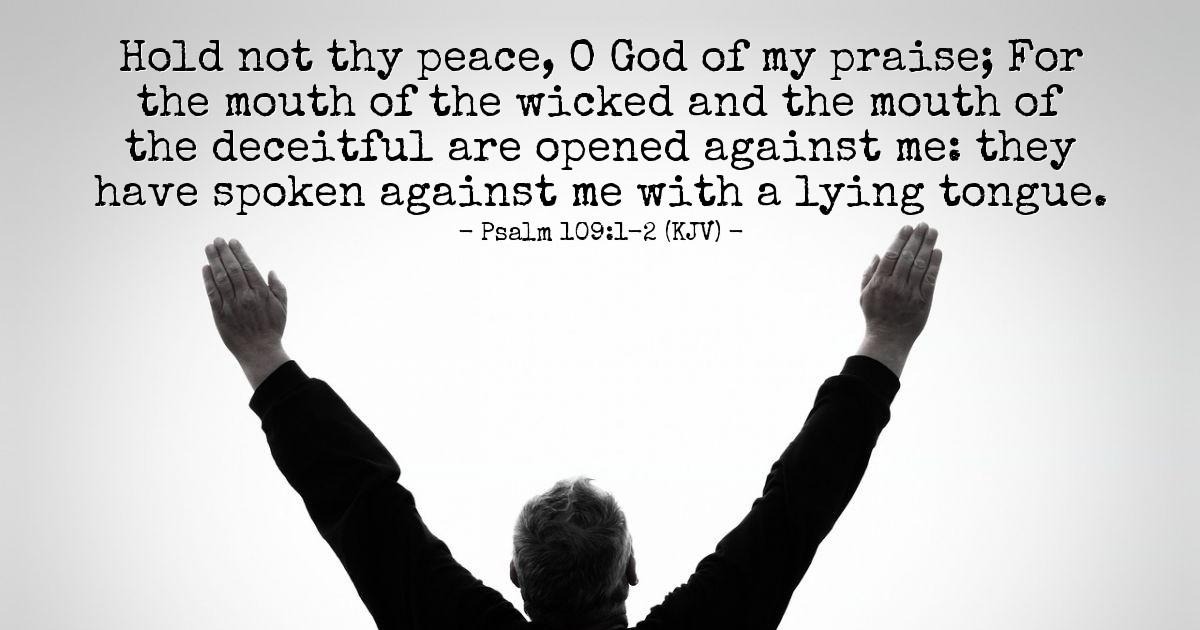
Psalm 109 contains some of the strongest language in the bible. In recent times it has worried churches about its suitability, but it is the Word of God, so what does it hold for us as a prayer group?
There is actually a hidden beauty in this passage where David shows us that we CAN bring our heart and soul to God in faith, like David, despite our state of anger and desperation, but how do we take if forward into prayer ministry.
I once shared it with my daughter when she was going through the pain of divorce. My intention was to show her that she was not alone. She surprised me by actually reading it and her reaction was “My goodness, someone has been hurt”.
She was right. This psalm is about HURT, personal and individual hurt. Today’s devotion is to carefully understand how our prayer ministry can engage people hurt by betrayal or fractured love. Both of these problems are very common starting points to depressive episodes and constantly churning despair.
Structure
Let’s take a look at the structure of psalm 109.
- Verses 1 to 5 are an expression firstly on God’s supremacy (my God who I praise…) and in verse 5 we see the problem in a general case of a personal hurt inflicted on the psalmist.
They repay me evil for good,
and hatred for my friendship.
- Verses 6 to 20 are the deeply emotional verses where we discover that these calls for vengeance are directed against an individual, for example v. 8
May his days be few;
may another take his place of leadership.
We must recognise that these are the words of a man unloading his heart, they are not licensed curses! This verse has actually been used in prayers by fundamentalists in politics to pray for leadership change! This is not the purpose of the psalm at all. The purpose is to share a situation that is placed before God.
- Verses 21 to 25 express the brokenness of the psalmist, shown clearly in v. 22
For I am poor and needy,
and my heart is wounded within me.
These cases, when we find them in our ministry have “Wounded Heart” as a significant symptom.
- Verses 26 to 31 show the resolution of the condition as the psalmist calls on God as a saviour from his sad turmoil. We see this in particular in vv. 26 and 27:
Help me, Lord my God;
save me according to your unfailing love.
Let them know that it is your hand,
that you, Lord, have done it.
This is a phase of appeal to God as well as acknowledging that it is God who will be the one to faithfully help, save and restore with vengeance passed to God’s hand rather than human intervention.
At this point we see that being a Christian in this situation has distinct value and joyous efficacy. This is where and why we share our faith in practical prayer ministry.
- Firstly, we empathise with the sufferer. The big temptation of a depressed person is to feel distanced from God. This psalm is clear that these thoughts CAN be shared with God, so our first task is to guide the sufferer to understand their value in the eyes of God. We can see this in Matthew 18:12-14
12 “What do you think? If a man owns a hundred sheep, and one of them wanders away, will he not leave the ninety-nine on the hills and go to look for the one that wandered off? 13 And if he finds it, truly I tell you, he is happier about that one sheep than about the ninety-nine that did not wander off. 14 In the same way your Father in heaven is not willing that any of these little ones should perish.
The lost, the hurt and the despairing are God’s priority and depressed people need to know that not only are they worthy of God, but that God seeks them out for salvation on a deeply personal basis.
- Our next steps are restorative. David’s approach is linked to Deuteronomy 32:35
“It is mine to avenge; I will repay. In due time their foot will slip;”
When we see God as a God of vengeance on our behalf, we may be misinterpreting this verse. God is teaching us that we need not even entertain ideas of vengeance – God claims that territory and in so doing says that we should set these thoughts aside. Proverbs 25:21-22 Tells us to love enemies rather than call for retribution:
If your enemy is hungry, give him food to eat;
if he is thirsty, give him water to drink.
In doing this, you will heap burning coals on his head,
and the Lord will reward you.
Jesus says in Matthew 5:44 44 But I tell you, love your enemies and pray for those who persecute you.
Building love is critical to restoration – let the pain go!
- And pray… Here again, Jesus points the way forward in Matthew 6. Vv 7 and 8 are critical:
7 And when you pray, do not keep on babbling like pagans, for they think they will be heard because of their many words. 8 Do not be like them, for your Father knows what you need before you ask him.
These are extraordinary words of comfort. We have seen that we are valuable, but how glorious is it that our Heavenly Father already knows how we feel and what we need? There is a wonderful turning point in this part of prayer ministry when your ‘patient’ actually appreciates this simple step for what it is. God understands, God knows what you need, God is there for YOU the special lost sheep. Suddenly the lights of your prayer partner turn on.
- And forgive…. You will find that the emotional turmoil in a depressed patient can seem endless and a way to evolve from this trap is to bring forgiveness. In this case it is not forgiving the depression, but asking a depressed person to be forgiving.
When depressed, people need forgiveness as part of restoration, and Jesus calls out the importance of being forgiving in order to be forgiven
14 For if you forgive other people when they sin against you, your heavenly Father will also forgive you. 15 But if you do not forgive others their sins, your Father will not forgive your sins.
Building forgiveness into a sufferer’s mind significantly eases their burden and goes a long way to reducing the mental spin cycle that can be so damaging and difficult to stop.
Forgiveness is curious. The reality is that forgiving an oppressor will have little effect on the antagonist. In fact, they might not even notice they have been forgiven. But remember forgiveness is not just an act of grace towards an enemy but an active faithful surrender of a problem into the hands of God where it belongs. The ‘forgiver’ finds forgiveness from God at a time when it is at its most valuable in conquering emotional turmoil.
- Engage, restore, forgive, pray, repeat. Sometimes this does not appear to work. You may find cases where you go through the whole cycle with no apparent success. After intensive counselling you find your respondent goes right back to the beginning and they are still in turmoil. Two things to remember at this point:
- Recovery from a serious episode of broken love can take time and persistence
- Sometimes you may say to yourself that the message is not getting through. This is a common reality of spiritual warfare compounding the depression event
Spiritual warfare can interfere with God’s message reaching the lost. It is a wise move to build a prayer shield in order that spiritual clarity and comfort is truly built. Pray not only for your partner, but also for yourself that your heart is also protected as well as that of your prayer partner.
Discovering a close relationship with Jesus, our friend and saviour, is ultimately the way out of depressive episodes. Think about the wonderful words we have just sung:
“What a friend we have in Jesus, all our sins and griefs to bear!”
“O what peace we often forfeit, O what needless pain we bear, all because we do not carry everything to God in prayer!”
“Have we trials and temptations? Is there trouble anywhere? We should never be discouraged; take it to the Lord in prayer!”
“In His arms He’ll take and shield thee; thou wilt find a solace there”.
Joseph Scriven 1855